Under the theme “From Tissue to Answer”, the launch anchors a comprehensive pathology portfolio spanning tissue and molecular pathology. Whether the question is asked of proteins in a tissue section or of nucleic acids in a sample, MGI’s platforms deliver an accurate answer with AI embedded at every step.
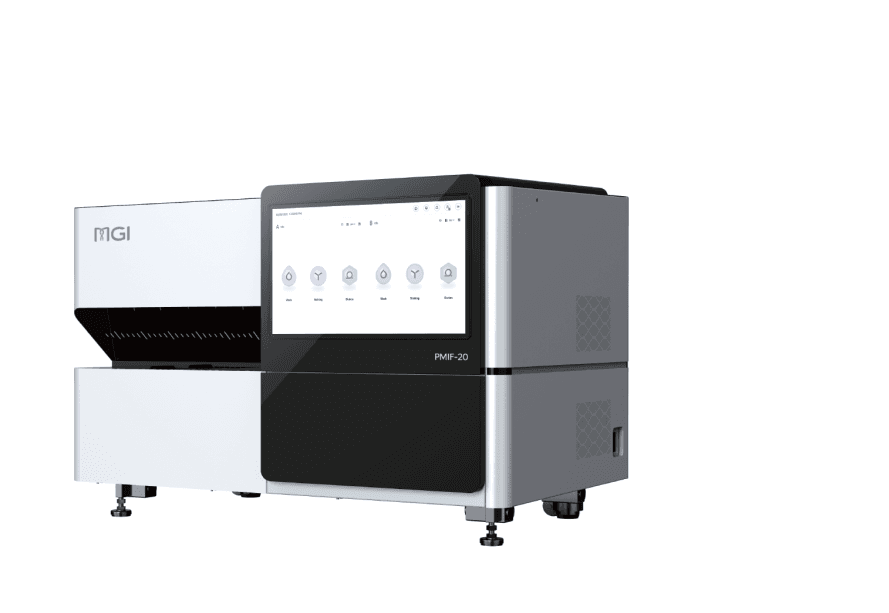
VisiOmics (PMIF-20RS)* is now commercially available in Europe
VisiOmics (PMIF-20RS) is a fully automated mIF staining and imaging system that brings high-plex, automated tissue analysis within reach of routine laboratory workflows. VisiOmics enables multiplex detection of protein markers within a single tissue section, allowing researchers to characterize cell populations and investigate their spatial organization within the tissue microenvironment:
More than 20-plex detection per run, expandable to more than 100 markers from a single tissue section via cyclic staining
Walk-away automation of the full staining-to-imaging workflow
AI-powered image analysis with FluoXpert Vision including cell segmentation, phenotyping and spatial analysis, supported by a dedicated AI assistant that lowers the barrier for downstream analysis and data visualization.
“To gain deeper insights into disease biology, pathology research is increasingly combining morphological assessment with multiplex spatial proteomics,” said Fang Chen, Vice President of MGI and General Manager of Europe & Africa at MGI. “With VisiOmics now available in Europe, alongside PrepALL and AIO for molecular pathology, we are offering a complete ‘From Tissue to Answer’ portfolio, whether the starting point is proteins in tissue or nucleic acids in a sample.”
MGI is also partnering with the Fraunhofer Institute for Integrated Circuits IIS to demonstrate the compatibility of multiplex immunofluorescence images generated by VisiOmics (PMIF-20RS) with MIKAIA®, Fraunhofer IIS’s image analysis software for digital pathology and spatial biology research. The collaboration aims to show how researchers can use VisiOmics image data within MIKAIA workflows for cell segmentation, phenotyping and spatial analysis. This work supports greater flexibility in downstream analysis, helping laboratories connect automated tissue imaging with tools suited to their research questions.
Also on display: Customisable High-Throughput Multiplex Tissue Imaging
AI-based pathology research depends on well-characterised tissue image datasets. To support their generation at scale, MGI is also presenting Path-P96 WF, a customisable platform for automated multiplex immunofluorescence staining and imaging using standard pathology slides. The system processes up to 32 slides per batch, supports continuous loading and walk-away operation, and enables detection of more than 100 protein markers through cyclic staining.
Designed to accommodate different research workflows, Path-P96 WF can be configured for applications in drug discovery and spatial biology, including target validation, spatial phenotyping and image dataset generation for AI-based pathology research.
Molecular pathology: From Library Prep to Integrated Reporting
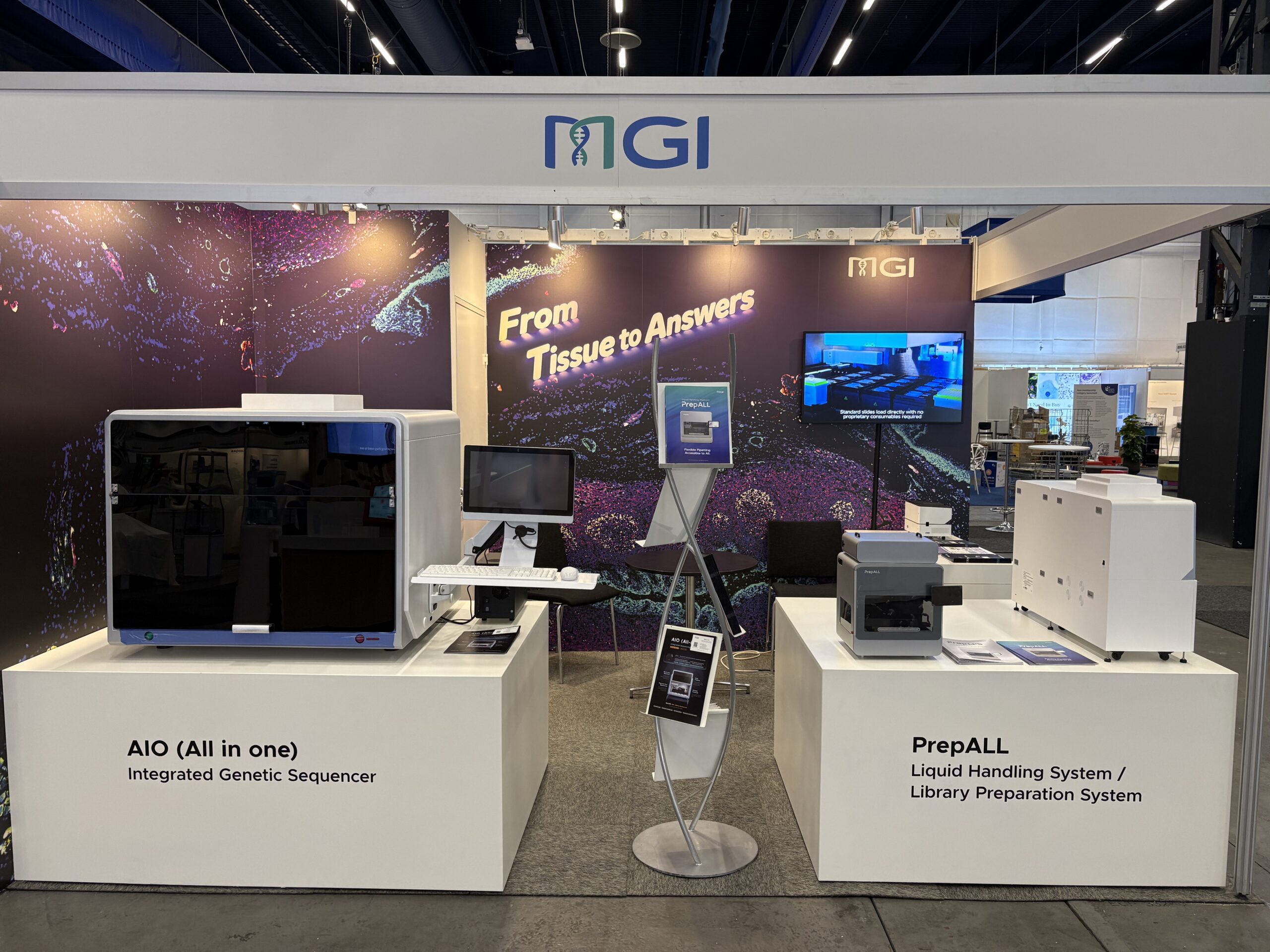
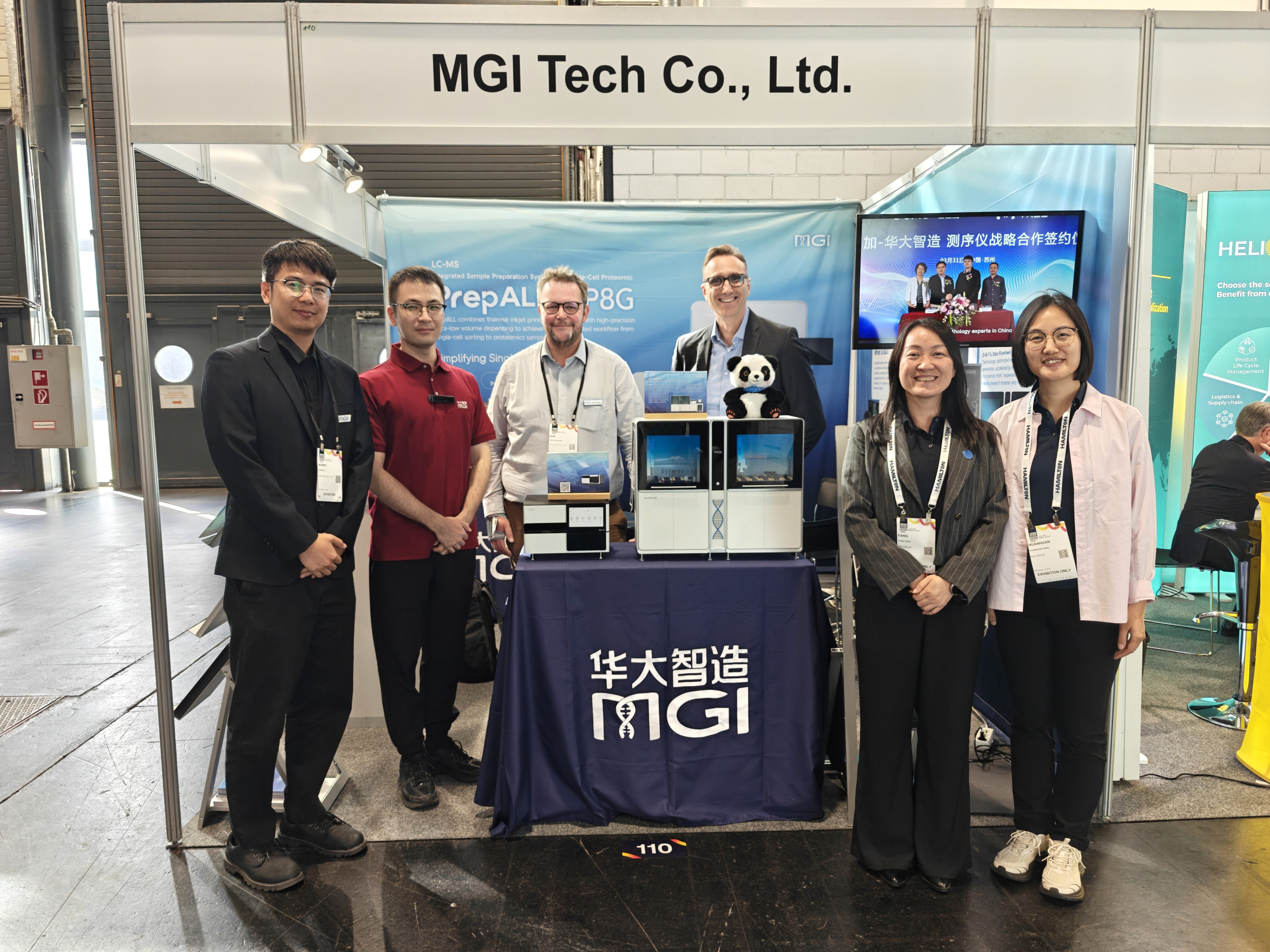
MGI now offers PrepLPS (PrepALL Library Prep Edition), a compact liquid-handling platform for NGS library preparation with eight independent channels (0.5–1,200 µL), AI-based machine vision and ready-to-run workflows. Early Access is now open for European laboratories, with a live system running at the booth.
AIO (All-in-one) condenses the entire workflow (library preparation, sequencing and reporting) into a single sample-to-result platform: nucleic acid in, report out, in about 11 hours with roughly 10 minutes of hands-on time. AIO 2.0 is demonstrated live at the booth, and the platform is open for OEM partnerships in Europe.
AI Across the Portfolio: From Analysis to Intelligent Lab Agents
Across the portfolio, AI is built in, not bolted on. Backed by Genoria AI, an MGI AI subsidiary launched in March 2026, each platform ships with AI-powered image analysis (FluoXpert Vision on PMIF-20RS), natural-language workflow orchestration on Path-P96 WF, machine-vision monitoring on PrepALL, and intelligent library-pooling strategies on AIO.
Europe remains a strategic region for MGI. Through continued investment in sequencing innovation, automation, clinical partnerships and collaborative ecosystem development, MGI is helping accelerate the transition toward more precise, data-driven healthcare.
*for research use only
About Fraunhofer IIS
As the largest Fraunhofer Institute, Fraunhofer Institute for Integrated Circuits IIS, headquartered in Erlangen, is a global leader in applied research, driving innovation for transformative products and services that shape the digital future.
Across seven research divisions, the institute develops pioneering solutions that advance technological progress, enhance economic competitiveness, and promote a sustainable society. Its strong performance is built on four core areas of expertise: artificial intelligence, microelectronics, data acquisition and analysis, and signal processing and data transmission. These competencies are combined strategically to meet the specific needs of its clients.
Learn more at Fraunhofer IIS.
About Genoria AI
Genoria AI, a subsidiary of MGI Tech, is an AI4S company building self-evolving labs to scale agentic discovery.
Learn more at genoria.ai


Molecular Pathology
Proteomics
Genomics
Share