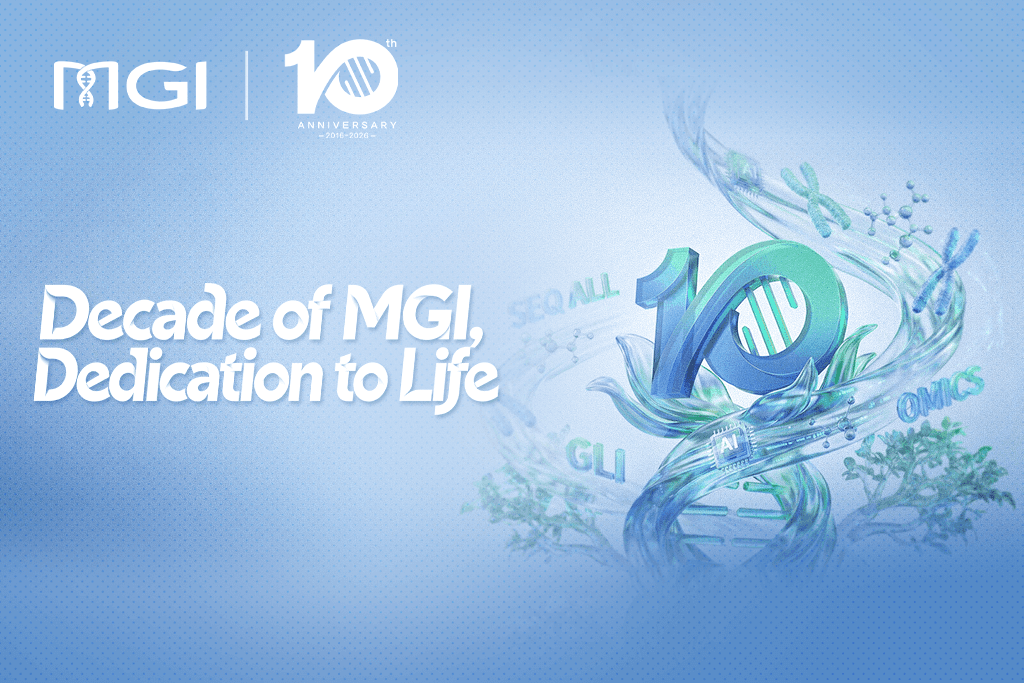
MGI Tech Co., Ltd. (MGI), a Shenzhen-based global leader in life science tools and DNA sequencing technology, marks its 10th anniversary with a decade of breakthroughs that have transformed genomics from a specialist capability into scalable, AI-powered scientific infrastructure. Founded in 2016, MGI now serves researchers and clinicians across six continents — delivering sequencing platforms, intelligent laboratory systems, and integrated multi-omics solutions that power discovery in medicine, agriculture, and environmental science.
From Research Tool to Global Genomic Infrastructure: A Decade of Platform Innovation
When MGI launched its first sequencing platforms, next-generation sequencing (NGS) was operationally rigid, physically large, and prohibitively expensive for most institutions. MGI's founding philosophy, "to advance science, one must sharpen one's tools", set its direction: build the foundational instruments that make genomics accessible at scale.
Key sequencing milestones (2016–2025)
The early DNBSEQ-G400 and DNBSEQ-G50 platforms introduced streamlined workflows that opened high-quality sequencing to a broader range of laboratories. In 2018, the DNBSEQ-T7 raised the bar for ultra-high-throughput sequencing, enabling up to 60 human genomes per day and marking a pivotal shift in production-scale genomics.
In 2022, MGI launched the DNBSEQ-E25, the world's first sequencer based on self-luminous sequencing technology, alongside the compact DNBSEQ-G99 for mid-to-low throughput settings. Both platforms were validated under extreme conditions, including high-altitude deployment on Mount Everest, demonstrating the geographic adaptability of MGI's sequencing technology in challenging environments.
By 2023, the DNBSEQ-T20×2 "Super Sequencing Factory" redefined the economics of population genomics: capable of sequencing up to 50,000 human genomes per year, it helped push the cost of whole-genome sequencing (WGS) below $100 per genome, a landmark threshold for national genomics programs globally.
In 2025, next-generation platforms including the T1+ and T7+ further increased data density, delivering terabyte-scale sequencing output within 24-hour turnaround cycles.
Intelligent Laboratory Automation: From Sample Preparation to Multi-Omics Insights
As life science enters the era of large-scale biological datasets, data generation is no longer the bottleneck, workflow speed, reproducibility, and precision are. MGI has expanded well beyond sequencing instruments to build intelligent laboratory ecosystems that automate the full research workflow.
Automation at scale
Platforms such as the SP-960 and SP-Smart8 automate critical steps from sample preparation to library construction, reducing manual variability and significantly increasing throughput in high-volume laboratories. For maximum integration, the D4 digital microfluidics platform offers a fully enclosed, end-to-end automated solution.
Single-cell and spatial analysis
MGI's DNBelab C Series, including the C4 and C-YellowR 16, enables high-resolution single-cell RNA sequencing and proteomics, allowing researchers to map complex biological systems at cellular resolution. These platforms form part of a broader ecosystem shift toward AI-enabled, modular, and automated multi-omics workflows.
Integrated Multi-Omics: Short-Read, Long-Read, and Spatial Sequencing in One Ecosystem
Modern biological research increasingly requires the integration of multiple sequencing modalities. Mixing platforms from different suppliers often introduces technical incompatibilities and workflow inefficiencies. Following the acquisitions of STOmics and CycloneSEQ, MGI has become one of the world's only life science technology companies capable of delivering a fully integrated sequencing ecosystem, combining:
Short-read sequencing (DNBSEQ): high-throughput genomic profiling
Long-read nanopore sequencing (CycloneSEQ): structural variant detection and full-length transcript analysis
Nanoscale spatial transcriptomics (Stereo-seq / STOmics): molecular mapping within intact tissues
Single-cell omics and proteomics: functional network and protein dynamics analysis
Together, these capabilities form the foundation of MGI's SEQALL + GLI + Omics strategy, integrating sequencing technologies, Generative Lab Intelligence (GLI), and multi-omics solutions into a unified platform for next-generation biological research.
AI-Powered Genomics: From Rule-Based Workflows to Generative Lab Intelligence
Artificial intelligence is reshaping how researchers interact with genomic data. MGI's G400RS FluoXpert Vision brings AI to single-cell spatial analysis in multiplex immunofluorescence studies, powered by an AI assistant built on the DeepSeek V3 large language model (LLM). Researchers can process and visualise complex multi-dimensional datasets through natural-language workflow prompts, reducing time-to-insight and lowering the barrier to advanced analysis.
The PMIF-20 Multiplex Fluorescent Staining and Imaging System further automates spatial proteomics workflows, enabling high-resolution characterisation of the tumour microenvironment and cellular interactions in oncology research.
Real-World Impact: Precision Medicine, Public Health, and Population Genomics
The expansion of MGI's sequencing capacity over the past decade has directly supported national genomics programs, rare disease diagnostics, oncology sequencing initiatives, and global public health surveillance. Whole-genome sequencing (WGS) has transitioned from a research output to a clinically integrated workflow across hospitals, research institutions, and population-health programs worldwide.
"Over the past decade, genomics has transitioned from specialized capability to foundational scientific infrastructure. The responsibility now is to build open, intelligent systems that reduce barriers to access while maintaining rigor and enabling sustainable precision medicine worldwide." — Duncan Yu, President, MGI Tech
What's Next: The $10 Genome and the Era of Biological Intelligence
Industry consensus is converging on a next major threshold: reducing the cost of whole-genome sequencing to $10 per genome. Achieving this would fundamentally redefine preventive medicine, population health management, global disease surveillance, precision agriculture, and environmental monitoring.
MGI's second decade will be defined by the convergence of large-scale biological data, artificial intelligence, and intelligent laboratory automation, advancing toward a future where genomic insight is universally accessible and clinically actionable worldwide.
Connect with MGI Tech's global teams to explore collaboration opportunities: Research partnerships, Clinical genomics deployment, OEM & distributor inquiries, Publication collaborations

Real-World Impact: Precision Medicine, Public Health, and Population Genomics
"Over the past decade, genomics has transitioned from specialized capability to foundational scientific infrastructure. The responsibility now is to build open, intelligent systems that reduce barriers to access while maintaining rigor and enabling sustainable precision medicine worldwide." — Duncan Yu, President, MGI Tech



DNA sequencing platform
Multi-omics
Precision medicine
Single-cell analysis
Automation platform
Share