Environmental DNA: reading life from water, soil, and air
May 6, 2026
Share article

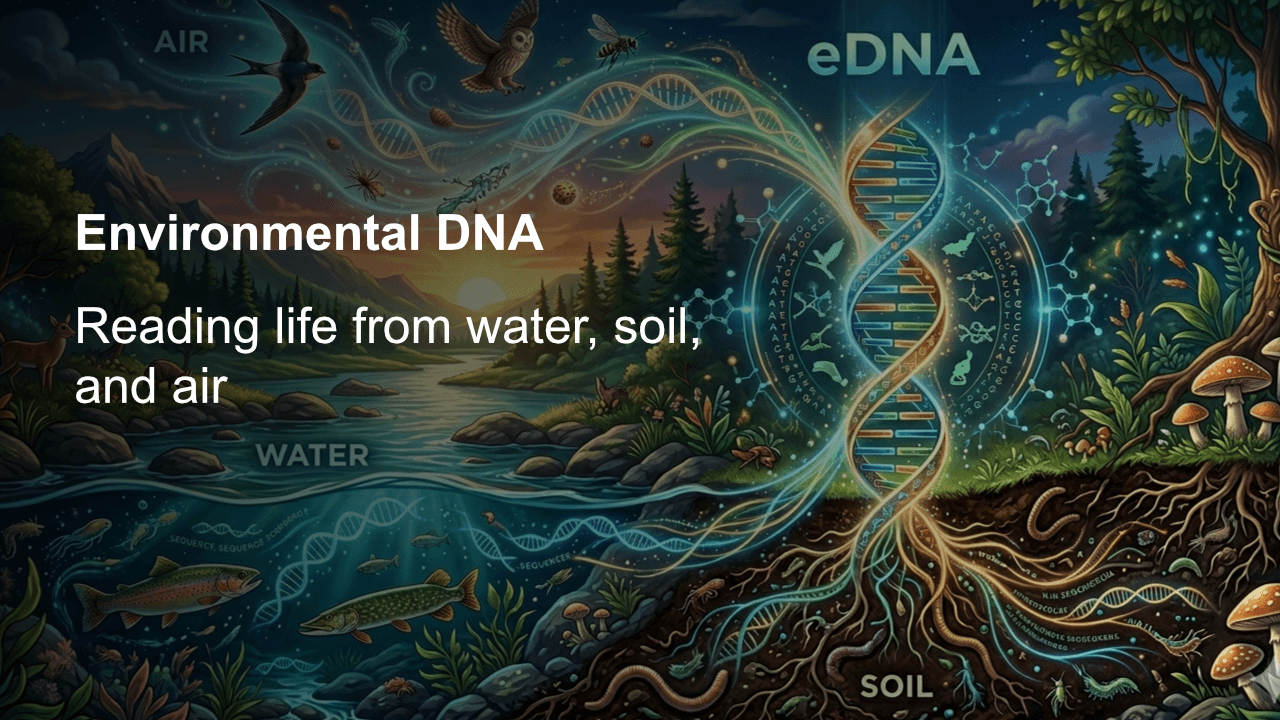
Environmental DNA (eDNA) is transforming how we study life on Earth, allowing scientists to detect species from traces in water, soil, and air. Powered by next-generation sequencing, it enables faster, non-invasive biodiversity monitoring at unprecedented scale.
Every organism leaves a genetic fingerprint in its environment. Environmental DNA (eDNA) is transforming how we monitor biodiversity, detect invasive species, and protect ecosystems at planetary scale. Combined with the speed and scale of modern next-generation sequencing, it is one of the most significant methodological advances in ecology and conservation science of the past two decades. Here is what it is, how it works, and why next-generation sequencing is the engine behind it.
1.What is environmental DNA?
Every living organism continuously sheds genetic material into its surroundings. Fish release DNA through mucus and scales sloughed into the water column; soil invertebrates leave traces through faeces and decomposing tissue; plants disperse pollen carrying their full genomic signature. This shed material, collected from the environment rather than from the organism itself, is what scientists call environmental DNA, or eDNA.
The concept is not new. Microbial ecologists have been extracting and analysing DNA from soil and water samples for decades. What has changed is the resolution and scale at which we can work. The dramatic fall in sequencing costs since the early 2010s, driven by next-generation sequencing (NGS) platforms, means that a single water sample can now be screened against databases of millions of reference sequences, identifying not just one target species but entire biological communities simultaneously.
eDNA degrades over time under the influence of UV radiation, temperature, microbial activity, and pH. In most freshwater systems, detectable eDNA persists for between 24 hours and a few weeks, meaning a positive detection reflects genuinely recent biological presence. This temporal specificity, combined with spatial resolution that can be tuned by sampling design, makes eDNA a powerful complement to conventional biosurvey methods.
Aquatic environments: Rivers, lakes, estuaries, and marine systems. DNA is shed continuously into the water column via mucus, faeces, urine, gametes, and shed cells. Water is the most studied eDNA matrix.
Soil and sediment: Particularly rich in microbial and fungal eDNA; also used for terrestrial vertebrate detection and agricultural pathogen surveillance.
Air: Pollen, fungal spores, and fine aerosols carry eDNA detectable via air filtration; an emerging frontier for allergen monitoring and biosecurity.
Ice and permafrost: Ancient eDNA preserved in ice cores can reconstruct past ecosystems, offering a palaeogenomic archive of biodiversity through time.
2.The eDNA workflow: from field to result
An eDNA study involves five conceptually distinct phases, each with its own quality controls and methodological choices. The sequencing platform selected in phase four directly determines the throughput, cost, and taxonomic resolution of the final data.
Sample collection
Water samples (typically 1–5 litres) are collected using sterile containers or peristaltic pumps. Strict contamination-prevention protocols are essential: field blanks, gloves, and equipment decontamination between sites. Soil cores, air filters, or sediment grabs are used for terrestrial applications.
Filtration and DNA extraction
Water is filtered through membranes to capture cells and DNA. Filters are preserved in lysis buffer or liquid nitrogen. DNA is extracted using commercial kits optimised for environmental samples, eluted in low-EDTA TE buffer to preserve integrity.
Library preparation
Target gene amplicons are amplified by PCR with dual-indexed, barcoded primers. Kits such as MGI's MGIEasy Universal DNA Library Prep Set and MGIEasy Fast FS Library Prep Set V2.0 are validated for low-input environmental DNA.
NGS sequencing
Pooled libraries are then sequenced on a sequencing platform.
Bioinformatics and reporting
Raw reads are quality-filtered, primers trimmed, and assembled. Taxonomy is assigned against curated databases. Results feed into biodiversity indices, species occurrence matrices, or regulatory reports.
3.Technologies for eDNA analysis
The choice of analytical method depends on the biological question, the required resolution, and the budget. Four major approaches are in active use, each with distinct strengths.
High throughput: Next-generation sequencing (NGS)
The sequencing backbone of both metabarcoding and metagenomics. Modern NGS platforms generate tens to hundreds of millions of reads per run, enabling large sample cohorts at a cost per read orders of magnitude lower than first-generation Sanger sequencing.
Community-level: Metabarcoding
Amplifies a short, taxonomically informative gene region from a complex mixture of environmental DNA. Primers targeting COI, 12S, 16S, 18S, or ITS recover hundreds of taxa simultaneously. Output is species occurrence and relative abundance data across entire communities.
Full resolution: Shotgun metagenomics
Sequences all DNA in a sample without targeted amplification. Provides taxonomic, functional, and phylogenetic information at unprecedented depth. Reveals unculturable microbes, viral communities, and rare species missed by amplicon approaches.
Species-specific: Quantitative PCR (qPCR / ddPCR)
Targets a single species with high sensitivity and quantitative output. Used for invasive species surveillance, pathogen monitoring, and detection of critically endangered species where qualitative presence/absence is the primary question.
4.Key applications and impact areas
Biodiversity monitoring and assessment
Traditional biosurveys (electrofishing, kick-sampling, transect counts) are labour-intensive, seasonal, and observer-dependent. eDNA metabarcoding can survey entire aquatic communities from a morning's sampling effort, with data reproducible across laboratories and comparable across years. For national park agencies, water utilities, and conservation organisations managing hundreds of sites, this scalability is transformative.
Invasive species early detection
eDNA can detect invasive species from environmental samples weeks before visual sighting becomes possible, when population densities are still low enough for management intervention to be effective. The US Geological Survey has deployed eDNA surveillance across the Great Lakes basin for Asian carp since 2009; European programmes are applying the same principle to signal crayfish, quagga mussel, and topmouth gudgeon.
Endangered and protected species monitoring
For species where disturbance itself is a conservation risk (cryptic amphibians, nocturnal mammals, deep-sea fish) eDNA allows presence/absence confirmation without trapping, handling, or habitat disruption. This is particularly valuable in legally protected areas where survey licences are difficult to obtain, or in habitats that are physically inaccessible.
Regulatory and statutory bioassessment
Regulatory adoption is accelerating. eDNA-based assessment of fish communities is now accepted under several national implementations of the EU Water Framework Directive (WFD). Environmental consultancies routinely include eDNA surveys in Environmental Impact Assessments for infrastructure, dredging, and development projects. Standardisation bodies including CEN and ISO are actively developing formal eDNA protocols to facilitate cross-border comparability of data.
Wastewater and pathogen surveillance
The COVID-19 pandemic demonstrated that wastewater eDNA surveillance can provide population-level epidemiological signals days before clinical case reporting, a capability now being extended to influenza, antimicrobial resistance genes, and enteric pathogens. The same analytical infrastructure used for biodiversity surveys can be repurposed for public health monitoring.
References
Bohmann, K., Evans, A., Gilbert, M. T. P., Carvalho, G. R., Creer, S., Knapp, M., Yu, D. W., & de Bruyn, M. (2014). Environmental DNA for wildlife biology and biodiversity monitoring. Trends in Ecology & Evolution, 29(6), 358–367. https://doi.org/10.1016/j.tree.2014.04.003
Callahan, B. J., McMurdie, P. J., Rosen, M. J., Han, A. W., Johnson, A. J. A., & Holmes, S. P. (2016). DADA2: High-resolution sample inference from Illumina amplicon data. Nature Methods, 13(7), 581–583. https://doi.org/10.1038/nmeth.3869
Deiner, K., Bik, H. M., Mächler, E., Seymour, M., Lacoursière-Roussel, A., Altermatt, F., Creer, S., Bista, I., Lodge, D. M., de Vere, N., Pfrender, M. E., & Bernatchez, L. (2017). Environmental DNA metabarcoding: Transforming how we survey animal and plant communities. Molecular Ecology, 26(21), 5872–5895. https://doi.org/10.1111/mec.14350
Ficetola, G. F., Miaud, C., Pompanon, F., & Taberlet, P. (2008). Species detection using environmental DNA from water samples. Biology Letters, 4(4), 423–425. https://doi.org/10.1098/rsbl.2008.0118
Medema, G., Heijnen, L., Elsinga, G., Italiaander, R., & Brouwer, A. (2020). Presence of SARS-CoV-2 RNA in sewage and correlation with reported COVID-19 prevalence. Environmental Science & Technology Letters, 7(7), 511–516. https://doi.org/10.1021/acs.estlett.0c00357
Metzker, M. L. (2010). Sequencing technologies—The next generation. Nature Reviews Genetics, 11(1), 31–46. https://doi.org/10.1038/nrg2626
Taberlet, P., Coissac, E., Hajibabaei, M., & Rieseberg, L. H. (2012). Environmental DNA. Molecular Ecology, 21(8), 1789–1793. https://doi.org/10.1111/j.1365-294X.2012.05542.x
Thomsen, P. F., & Willerslev, E. (2015). Environmental DNA – An emerging tool in conservation for monitoring past and present biodiversity. Biological Conservation, 183, 4–18. https://doi.org/10.1016/j.biocon.2014.11.019
U.S. Geological Survey. (n.d.). Environmental DNA (eDNA). Retrieved from https://www.usgs.gov
European Commission. (n.d.). Water Framework Directive (WFD). Retrieved from https://environment.ec.europa.eu
International Organization for Standardization. (n.d.). Environmental DNA (eDNA) standards. Retrieved from https://www.iso.org
World Health Organization. (2022). Environmental surveillance for SARS-CoV-2 to complement public health surveillance. Retrieved from https://www.who.int



Share this article :
Share
